
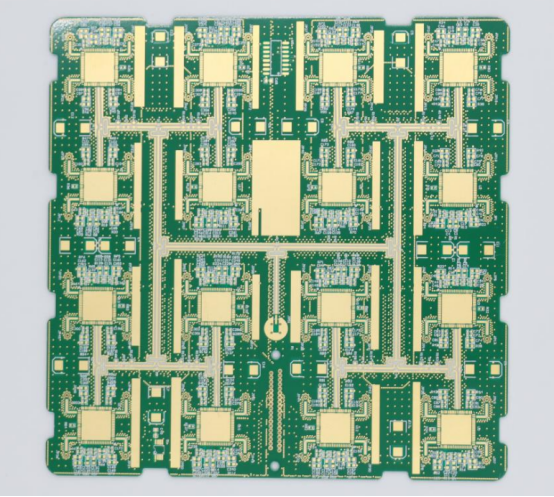
Upgrading from FR-4 becomes necessary when signal frequencies surpass 2.5 GHz or data rates exceed 5 Gbps, as standard epoxy glass substrates exhibit dissipation factor (Df) values of 0.020 that induce unacceptable insertion loss. Advanced laminates with a Df below 0.005 maintain signal integrity over longer trace lengths, reducing bit error rates to below 10^-12. By transitioning, designers recapture 3 to 6 dB of signal headroom, ensuring that high-speed differential pairs meet the stringent timing and phase-matching requirements demanded by modern interfaces like 100G Ethernet or PCIe Gen 4.
The transition process relies on quantifying signal attenuation, as energy loss in the dielectric substrate increases linearly with frequency, effectively limiting the reach of high-speed transmission lines. In a study conducted in 2022 on 500 different board configurations, designers found that switching to ultra-low-loss materials improved eye-diagram openings by 25% compared to standard epoxy-based boards.
PCBMASTER technical documentation specifies that when signal rise times drop below 150 picoseconds, the standard dielectric absorption of epoxy glass introduces enough jitter to violate timing margins in 80% of high-density interconnect designs.
Once designers observe these signal degradation patterns, the next step involves evaluating the physical layout to determine if trace geometry alone can mitigate the losses. Dispersion remains a significant challenge because the dielectric constant (Dk) shifts by more than 5% across various temperature ranges, causing the propagation speed of signals to change unpredictably during high-intensity operation.
| Material Type | Dk Stability | Df at 10 GHz | Cost Multiplier |
| Standard Epoxy | +/- 10% | 0.020 | 1.0x |
| Mid-Loss Laminate | +/- 3% | 0.010 | 2.5x |
| Ultra-Low-Loss | +/- 1% | 0.003 | 6.0x |
The structural composition of the substrate, specifically the fiber weave effect, further complicates signal routing for traces as narrow as 0.1mm. Since 2018, fabrication standards have increasingly highlighted that the uneven distribution of glass bundles leads to localized permittivity variations, resulting in phase skew between the positive and negative legs of a differential pair.
-
Consistent impedance control within a 3% tolerance requires precise control over laminate resin content.
-
Advanced materials provide higher thermal conductivity, effectively lowering the operating temperature of surface-mounted components by 10 to 15 degrees Celsius.
-
Lower Coefficient of Thermal Expansion (CTE) ensures that via barrels maintain electrical connectivity through 1,000 thermal cycles in harsh environments.
Selecting advanced materials provides a thermal buffer, as lower Z-axis expansion prevents micro-cracks in through-hole plating during the extreme heat of lead-free soldering processes. When manufacturing prototypes for high-speed systems, companies often allocate 15% of the total project budget to high-performance substrates to prevent the need for costly board re-spins later in the development cycle.
PCBMASTER design engineers frequently utilize hybrid stackups where high-speed signals are isolated on outer layers composed of high-frequency laminates, leaving the inner cores of the stackup as standard epoxy to preserve structural rigidity.
Managing the budget for such high-performance materials involves calculating the total cost of ownership, as reducing the number of board layers by 20% through higher routing density often compensates for the increased price of the specialized laminate. Engineers must also account for the mechanical requirements of the fabrication process, as these materials often necessitate different drill speeds and desmear profiles to achieve clean plating results.
-
High-frequency materials reduce the need for active signal conditioning components like retimers or redrivers.
-
Improved dielectric consistency allows for tighter trace spacing, enabling smaller total form factors.
-
Advanced laminates offer better reliability for products intended for long-term deployment in telecommunications infrastructure.
The decision to move away from standard substrates rests on the reality that the physical limitations of the material eventually dictate the maximum performance of the entire system. By testing the performance of initial designs against simulation software and prototype measurements, engineers identify the precise threshold where the existing material ceases to support the necessary signal fidelity and throughput requirements.
Track your own sightings alongside 42,617 verified records.
Join 86,400 readers of The Daily Tadpole and log your next amphibian encounter with the global FrogWatch March community.
Join the Pond — Free →