
Red Flags in OEM and ODM Fragrance Proposals for Hotel Lines
A fragrance proposal is easiest to judge by what it leaves out. The warning signs that matter are rarely dramatic; they are a price with no brief behind it, a compliance claim with no document attached, an exclusivity promise with no clause, a lead time expressed as one number. On a hotel or spa line those gaps cost more than on a single-product launch, because the same scent has to be supplied consistently to several properties over several years, and every missing document becomes a dispute later.
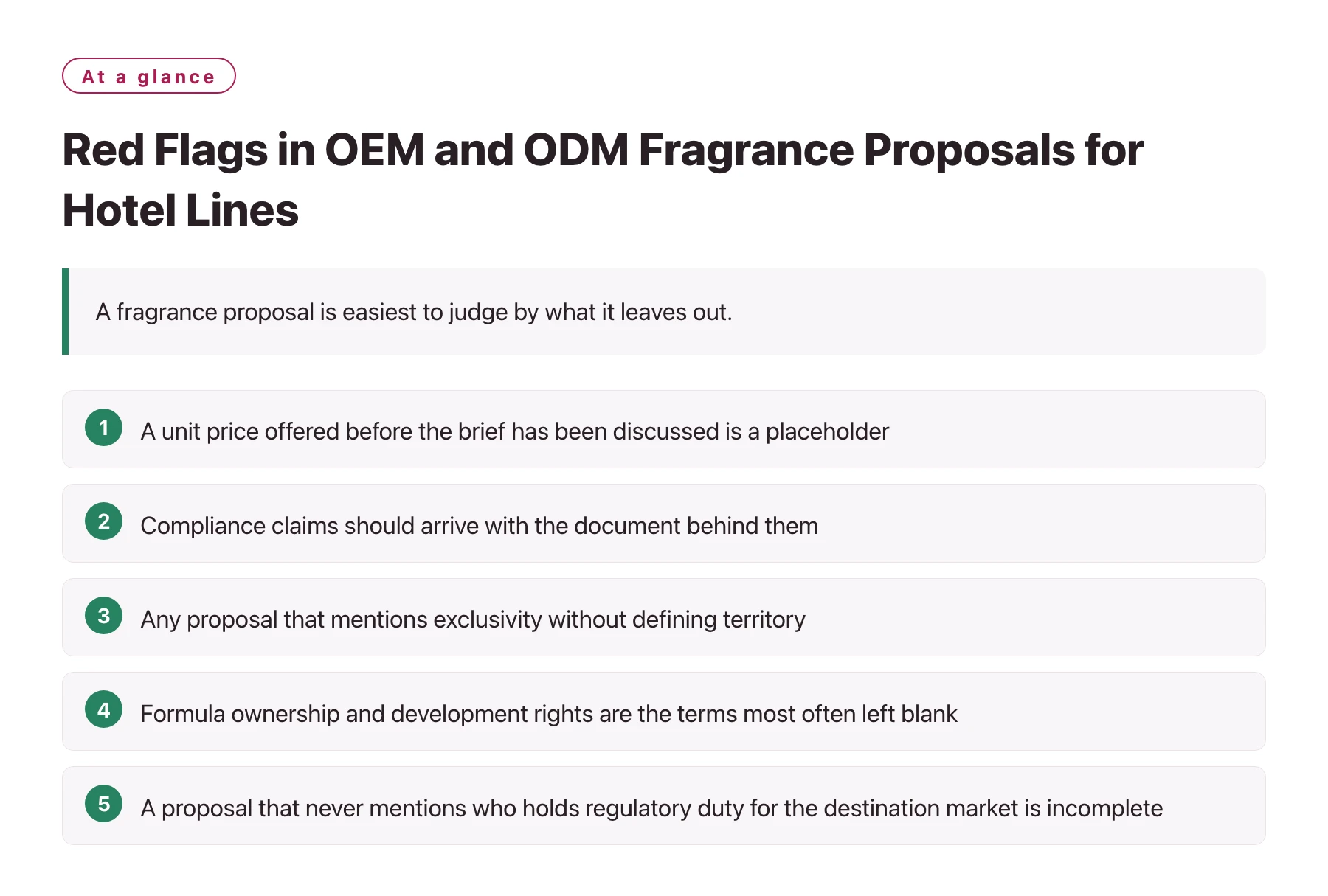
Key takeaways
- A unit price offered before the brief has been discussed is a placeholder, not a quote, and it usually hides assumptions about the fill, the format and the order quantity.
- Compliance claims should arrive with the document behind them, and a restricted-material statement that is not attached to a specific formula proves nothing [1].
- Any proposal that mentions exclusivity without defining territory, duration and scope is describing an intention rather than an obligation.
- Formula ownership and development rights are the terms most often left blank, and they are the ones that decide what a brand can do after the relationship ends [3].
- A proposal that never mentions who holds regulatory duty for the destination market is incomplete, because that duty sits with the finished product rather than with the fragrance concentrate [2].
- Test reports offered as a package deal rather than against a named fill should be treated as marketing material until they are reissued for your formulation [4].
Most buyers read a proposal looking for the number. That is the wrong first pass. The unit price is the least stable part of the document, because it moves the moment the fill, the format or the order quantity changes, and every serious supplier knows it.
The useful first pass is structural. Does the proposal describe the product as it will actually be made, in the format the property will use, with the compliance duties assigned and the ownership questions answered? A supplier that has run hospitality programmes will answer those points without being asked, because it has watched them become disputes before.
What follows are the warning signs worth acting on, separated into the ones that appear in the document itself and the ones that appear in how the document was produced. Both matter, and the second group is harder to fake.
Red flags in the document itself
The first is a complete-looking quote that answers a question you did not ask. If the proposal prices a fifty-millilitre spray without discussing base, format, decoration or volume, the number describes somebody else's project. It will change, and the change will arrive after you have built a budget around it.
The second is an exclusivity paragraph written in the conditional. Words such as could, may and typically indicate that the supplier has not committed to anything. Exclusivity in fragrance is a contractual restriction, so it needs the same treatment as any other commercial term: what is restricted, for whom, where and for how long.
Prices that have no visible floor under them
A price is a consequence of a brief. It follows the fragrance compound load, the packaging format, the decoration process, the filling method and the order quantity. A proposal that names a price without naming those inputs is useful only as a signal about how the supplier works, and the signal is not favourable.
The practical test is to ask for the same quote reissued against two different formats with everything else held constant. A supplier that can produce two coherent numbers understands its own cost structure. One that produces the same number twice, or cannot produce a second number at all, is worth how to compare perfume factories against alternatives before you go further.
Compliance language with nothing behind it
Compliance statements come in two forms: a sentence saying the product meets requirements, and a document showing how. The first is worth approximately nothing. What a buyer needs is the restricted-material picture for the specific formula, the allergen declaration that follows from it, and a clear statement of who holds the regulatory duty for the market where the product will be sold [1].
In the European Union that duty belongs to a responsible person established in the market, who also has to hold a product information file for the finished product [2]. A proposal that never identifies which party fills that role, and never mentions the file, is leaving the most consequential obligation unassigned.
Ownership terms that are missing rather than unfavourable
An unfavourable ownership clause can at least be negotiated. A missing one cannot, because there is nothing to negotiate against. Look specifically for what happens to the formula if the relationship ends, whether development work confers any rights, and whether packaging tooling paid for by the buyer transfers.
Registered rights work differently from contractual ones: a brand name or a distinctive bottle shape can be protected through trademark or design registration, while the formula itself is controlled through the agreement [3]. A proposal that treats all three as the same topic has not thought about it, and that is itself information.
What a complete proposal contains
| Element | What good looks like | What its absence signals |
|---|---|---|
| Scope statement | Names compounding, filling, packaging and decoration, and says which are in and out of scope | The supplier has not defined the boundary of its own responsibility |
| Cost structure | Separates compound, component, decoration, filling and freight | The unit price is a guess and will move at the first change |
| Restricted-material and allergen position | Attached to a described formula, with the market assumptions named | Compliance will become the buyer's problem without warning |
| Ownership and exclusivity terms | States formula rights, tooling ownership and any restriction in plain terms | Both topics will be revisited under pressure, probably during a dispute |
| Stage schedule | Lists stages with dependencies and the dates the buyer must meet | The single lead time quoted is a hope rather than a plan |
| Test and quality plan | Names which tests run, against which fill and packaging combination, and who pays | Verification rests entirely on the buyer after delivery |
Six rows is not a high bar, and a supplier that has run hospitality work will clear it without prompting. The reason to insist on the full set is that hotel and spa programmes multiply everything: one scent across several product bases, several properties and several reorder cycles. A gap that is survivable on a single retail launch becomes a recurring cost on an amenity line, which is why it is worth choosing a partner on the strength of fragrance manufacturing services in China described in this much detail rather than on the headline price.
Red flags in how the proposal was produced
Documents reveal process. A proposal assembled in two days with no questions asked usually means nobody read the request carefully. A proposal that arrives with three clarifying questions and a sample plan is slower and far more useful, because it shows the supplier is matching its answer to your project rather than to a template.
Ask who wrote the technical sections. If the commercial contact cannot explain how the compound cost was derived or which restricted materials were checked, the proposal was assembled for presentation rather than for production. That is a conversation you want to have before signing, not after the first bulk run.
Samples that arrive before the brief is understood
Fast samples are not automatically a good sign. If a supplier sends candidates before asking about the base, the format, the market or the price ceiling, the samples demonstrate a library rather than a fit. The same library may still be the right answer, but it should be chosen deliberately with the brief in view.
Test reports that describe someone else's product
A folder of certificates and reports is easy to produce and hard to read. Check what each report was run against. A compatibility or stability result for a different fill, format or alcohol level does not describe your product, and reissuing it for your combination is a cost somebody has to carry [4]. Establishing that in the proposal stage sets the expectation for the whole relationship.
Put the red flags to work as questions rather than as reasons to walk away. Send the same six-point checklist to every shortlisted supplier and compare the responses side by side: which scope statement is most specific, which cost structure survives being re-quoted for a second format, which ownership paragraph can be read by someone who is not a lawyer. The proposal that answers cleanly is usually also the one that will handle a batch problem cleanly, and the same discipline belongs in the wider list of things what to verify before signing with a fragrance manufacturer, applied once at the proposal stage and again before the first large order.
Sources
- IFRA Standards Library (International Fragrance Association) —— The IFRA Standards Library lists the restrictions the fragrance industry applies to individual fragrance ingredients, based on safety assessments; it is the reference point for compliant fragrance formulation.
- European Commission: Cosmetics in the EU —— The European Commission's overview of EU cosmetics rules, including the responsible person, product information file and safety report requirements.
- WIPO — World Intellectual Property Organization —— The UN agency for intellectual property; resources on industrial design and patent protection relevant to product and packaging design.
- SGS: Cosmetics, Personal Care & Household Testing —— Testing, inspection and certification services for cosmetics and personal care, including microbiological, stability and safety testing aligned with cosmetics GMP.
Frequently asked questions
Should a hotel ask for a sample before agreeing commercial terms?
Ask for a sample after the brief is understood, not before. A scent approved without a defined base, format and price ceiling tends to be re-approved later, which wastes the sampling round and resets the schedule. The most efficient order is brief, indicative pricing, sample, then commercial terms.
What does a valid exclusivity clause need to contain?
At minimum: which formula or composition is covered, which channels or territories are restricted, for how long, and whether hospitality properties specifically are excluded. Without those four elements the clause is a statement of intent, and it will not survive a change of account manager on either side.
Is a lower price a warning sign on its own?
Not on its own, but an unexplained lower price is. Ask what the price assumes about compound load, packaging grade, decoration and volume, and compare those assumptions across proposals. A quote that is low because it assumes a lighter fill and a stock bottle is not comparable to one that assumes a heavier fill and a custom vessel.
How can a buyer tell whether test reports apply to their product?
Read the description of what was tested. If it names a different fill, a different packaging material or a different format, the result does not transfer. Ask for the test to be run against your combination, or ask for a written statement of which results carry over and which do not.
What is the single clearest warning sign in a fragrance proposal?
A complete-looking document produced without a single question about the project. It indicates that the numbers were assembled for presentation rather than calculated for your product, and it usually means the compliance, ownership and schedule terms were copied from a template that was never adapted.
Track your own sightings alongside 42,617 verified records.
Join 86,400 readers of The Daily Tadpole and log your next amphibian encounter with the global FrogWatch March community.
Join the Pond — Free →